


Your company just completed Phase 1 of its digital transformation. New headless CMS: check. CDP integrated: check. AI capabilities roadmap: check. But when the CMO asks to see how you’re showing up in ChatGPT or Google’s AI Overviews, there’s an awkward silence. Your $12 million transformation forgot to transform the thing that actually appears in AI search: your content operations.
Across enterprise digital transformation programs, there’s a consistent blind spot. Organisations modernise their technology stack, adopt AI tools, and reorganise around customer experience—but leave content production trapped in 2015. Manual briefs. Email chains. Spreadsheet workflows. Small central teams drowning in coordination overhead while AI-powered search reshapes how customers discover and evaluate solutions. The transformation roadmap shows ‘content’ as complete, but the operational reality is a system that can’t scale, can’t govern, and can’t compete in an AI-driven search landscape.
This isn’t a technology problem or a headcount problem. It’s an infrastructure problem. Specifically, the missing layer between content strategy and content execution: AI-native content operations. This article examines why transformation programs fail at this critical juncture, what the gap actually costs in visibility and velocity, and what the missing operations layer needs to do.
We’ll walk through the three failure modes of enterprise content in transformation programs, expose the hidden costs of the operations gap, and outline the specific capabilities required in an AI-native content operations layer that can actually deliver on transformation promises without sacrificing governance.
The Content Operations Paradox: Why Transformation Programs Make It Worse
Digital transformation programs don’t just fail to fix content operations—they often make the problem more visible and more costly. By introducing new capabilities that existing workflows can’t support, transformation projects inadvertently highlight the operations gap while creating pressure for results that manual processes simply cannot deliver.
Symptom 1: The Martech Stack Nobody Can Feed
Enterprises invest heavily in headless CMS platforms, personalisation engines, and AI-powered recommendation systems, but these systems are content-hungry—they need velocity and volume that manual workflows can’t deliver. The gap manifests as ’empty’ personalisation (not enough content variations), ‘stale’ recommendation engines (can’t refresh content fast enough), and underutilised CMS capabilities sitting idle while teams struggle with basic content production bottlenecks.
Consider a global B2B software brand with 12-region presence that invested $2.3 million in a new headless CMS capable of supporting localised content at scale. The CMS can dynamically serve personalised content based on industry, company size, and user journey stage—but eighteen months post-launch, it’s sitting 60% empty. Why? Their central content team of seven people is still briefing agencies via PowerPoint presentations, managing review cycles through email chains, and manually coordinating across product, regional, and compliance stakeholders. The CMS has the capability to support thousands of content variations, but the operational reality is 3-4 new pages per month.
This scenario repeats across enterprise transformation programs. Marketing automation platforms that could nurture leads with sophisticated content sequences instead send the same generic emails because teams can’t produce enough content variations. CDP investments that promised personalised experiences at scale deliver basic demographic targeting because content operations can’t keep pace with the segmentation possibilities.
Symptom 2: AI Search Visibility Crisis
Transformation programs typically focus on AI capabilities for internal use—automation, analytics, personalisation—but ignore the external AI visibility challenge: how the brand appears in LLM-powered answers. According to SparkToro research, over 60% of Google searches now result in zero clicks¹, and Google’s AI Overviews appear for an increasing percentage of commercial queries. Enterprises need content structured for AI citation, not traditional keyword ranking.
AI search systems require structured, entity-rich content with clear FAQ sections and semantic markup—exactly what manual workflows can’t consistently produce at enterprise scale. Traditional enterprise content is optimised for ‘rank for keyword’ strategies, focusing on keyword density and traditional on-page SEO factors. But AI-powered answers pull from content that directly answers questions, includes structured data markup, and presents information in formats that language models can easily parse and cite.
The gap is stark. Recent analysis shows that only 23% of Fortune 500 companies appear in AI Overviews for their primary product category queries, compared to 67% of their smaller, more agile competitors². The difference isn’t product quality or market position—it’s content structure. Smaller companies using modern content operations can consistently produce the FAQ-driven, schema-annotated, entity-rich content that AI search systems prefer to cite.
Meanwhile, enterprises with superior products and deeper expertise remain invisible in AI search because their content workflows can’t systematically produce the structured formats these systems require. Manual briefing processes don’t encode AEO (Answer Engine Optimisation) requirements; email-based review cycles can’t ensure semantic markup consistency; spreadsheet content calendars can’t prioritise entity-rich content architecture.
Symptom 3: The Governance-Velocity Trap
Digital transformation creates more stakeholders and touchpoints—regional teams want localisation, product teams need feature content, compliance departments require review—but workflows remain linear and manual. The result is either governance breakdown (shadow content operations, brand drift, compliance risk) or velocity collapse (six-week lead times for a single landing page).
In practice, this manifests as central content teams becoming bottlenecks trying to review everything, junior team members sitting idle waiting for briefs, and agencies producing off-brand content because feedback loops are too slow to maintain quality control. A typical enterprise content approval workflow now involves 8-12 touchpoints: content strategy (brief creation), legal review (compliance check), product marketing (technical accuracy), brand team (voice consistency), regional marketing (local relevance), SEO team (optimisation requirements), and final approval from the content lead.
This linear workflow, managed through email and shared documents, creates 4-6 week cycle times for content that competitors produce in days. The governance requirements are legitimate—brand consistency, legal compliance, technical accuracy—but the operational model makes governance and velocity mutually exclusive rather than complementary.
Organisations face an impossible choice: maintain governance and accept that content velocity will kill transformation momentum, or abandon governance and accept the risk of brand drift, compliance violations, and quality inconsistency across markets. Both choices undermine transformation success, but most enterprises choose governance over velocity, effectively stalling their content-dependent transformation initiatives.
The Hidden Costs: What the Content Operations Gap Actually Costs Enterprise Teams
The content operations gap isn’t just an efficiency problem—it’s a measurable drain on transformation ROI, competitive position, and organisational capability. While enterprise leaders focus on technology investments and headcount optimisation, the operations gap quietly undermines both transformation credibility and market visibility.
Cost 1: The AI Search Invisibility Tax
Enterprise brands are losing share-of-voice in AI-generated answers because their content isn’t structured for LLM ingestion, while competitors with inferior products but better content structure appear as default recommendations in ChatGPT, Claude, and Google’s AI Overviews.
The invisibility tax is measurable and significant. BrightEdge research indicates that 64% of Google searches now include AI Overviews, and featured snippets appear in 42% of search results³. For high-intent commercial queries—the searches that drive qualified traffic—the percentage is even higher. Enterprise brands without presence in these AI-mediated results are effectively invisible to a growing segment of their target audience.
Consider this scenario: A Fortune 500 cybersecurity company with superior threat detection capabilities ranks #3 organically for “enterprise threat detection solutions.” Their smaller competitor ranks #7. But when users search the same query, the AI Overview cites the smaller competitor as the recommended solution because their content includes structured FAQ sections, clear feature comparisons, and schema markup that AI systems can easily parse and present.
The larger company has better technology, more customers, and stronger brand recognition, but loses the AI visibility contest because their content operations can’t systematically produce the structured, entity-rich content that AI search systems prefer. This isn’t a one-off problem—it’s systematic across thousands of commercial queries where AI systems increasingly mediate customer discovery.
Most enterprises have no visibility into their AI search presence because it requires different analytics approaches than traditional rank tracking. They’re optimising for rankings they can measure while losing visibility in the formats customers actually see. The invisibility tax compounds over time as AI-mediated search behavior increases and traditional organic click-through rates decline.
Cost 2: The Agency Dependency Margin Drain
Enterprise SEO content is typically outsourced at $500-2,000 per article, and at scale across markets and product lines, this represents millions in annual spend with inconsistent quality and slow turnaround times. For a global enterprise producing 500-1,000 SEO articles annually across regions and product categories, agency costs alone can reach $1.2-1.8 million per year.
But the visible agency costs are only part of the expense. The agency model requires extensive briefing—a manual process that consumes 8-12 hours of central team time per brief—and produces generic output that requires heavy editing before publication. When you factor in the briefing overhead, review cycles, and revision management, the true cost per published piece often exceeds $3,000.
A better operational model moves predictable SEO content in-house with AI-assisted production systems, reserving agency spend for high-value strategic work like thought leadership, brand campaigns, and complex product launches. Internal teams using AI content operations platforms can produce structured, brand-compliant SEO content at $200-400 per piece including platform costs and internal time, while dramatically reducing cycle times from weeks to days.
The margin improvement is significant: moving 60% of SEO content production in-house with AI-native operations can reduce annual content costs by $400,000-600,000 while improving velocity and brand consistency. But more importantly, it frees senior strategists from operational overhead to focus on the strategic work that AI can’t do: content architecture, competitive positioning, and brand evolution.
Cost 3: The Opportunity Cost of Senior Bottlenecks
Senior content strategists and SEO leads are spending 60-70% of their time on operational tasks: creating briefs, reviewing drafts, coordinating workflows, and answering questions from junior teams and regional stakeholders. These same professionals should be doing content architecture, competitive analysis, experimentation, and voice evolution—strategic work that determines competitive advantage and transformation success.
The opportunity cost is measurable in both salary dollars and strategic capability. A senior content strategist earning $140,000 annually who spends 65% of their time on operational coordination is effectively a $91,000 operations coordinator who occasionally does strategy work. Meanwhile, the strategic work goes undone: content architecture remains static, competitive gaps go unaddressed, and voice evolution stalls because senior talent is trapped in operational overhead.
This misallocation cascades through the organisation. Junior talent sits underutilised because they lack the frameworks and guardrails to execute independently. Regional teams create shadow content operations because central processes are too slow. Product teams bypass content strategy entirely because the operational friction makes collaboration impossible.
AI content operations platforms can redirect 40-50% of senior time from operational tasks to strategic work by providing automated briefing, governed workflows, and self-service capabilities for junior and regional teams. The value isn’t just the time savings—it’s the strategic capability that becomes available when senior talent can focus on competitive advantage rather than operational coordination.
Cost 4: The Transformation Credibility Gap
When board members or executive leadership ask “show me the AI transformation results,” visible content problems—slow velocity, poor search visibility, ongoing agency dependency—undermine confidence in the entire program. Content is the customer-facing proof point of transformation success or failure. If content operations still look pre-transformation, the whole initiative appears superficial.
This credibility gap has real consequences. Transformation programs compete for budget, executive attention, and organisational change capacity. Programs that can’t demonstrate operational improvements beyond technology installation risk budget cuts, leadership changes, or scope reduction in subsequent phases.
Content operations problems are particularly visible to executives because they directly impact customer experience and market visibility. When the CEO searches for the company’s primary value proposition and finds competitors appearing in AI Overviews while the company remains invisible, or when regional executives complain that content velocity is too slow to support product launches, the transformation program’s credibility suffers.
The gap manifests in board presentations where transformation leaders show impressive technology architecture diagrams while struggling to explain why content velocity hasn’t improved or why organic visibility is declining relative to AI-enabled competitors. Technology transformation without operational transformation creates a facade of progress that eventually collapses under scrutiny.
The Missing Layer: What AI-Native Content Operations Actually Requires
The solution isn’t more AI tools, more headcount, or more agency spend. It’s the infrastructure layer that sits between content strategy and content execution: a governed automation system that transforms strategic insights into executable content operations at enterprise scale.
Capability 1: Strategy-to-Brief Automation with Governance Rails
AI content operations platforms must automate the transformation of strategic insights into actionable, compliant content briefs without losing brand control or compliance oversight. This means moving from semantic analysis of existing content plus competitive gaps plus search demand to prioritised content roadmaps to structured briefs that encode brand voice, compliance requirements, and SEO/AEO best practices.
The key distinction is “governed automation” rather than ungoverned tools. Central teams define voice libraries, compliance templates, and content patterns once, then the system generates briefs that ensure consistency and completeness while allowing regional and junior teams to execute within established guardrails. Senior strategists review exceptions rather than every piece, dramatically reducing coordination overhead while maintaining quality control.
A practical example: Instead of a content strategist spending 8 hours creating a PowerPoint brief for a product feature page (researching keywords, analysing competitors, defining structure, specifying compliance requirements, outlining SEO elements), the AI system generates a structured brief in 10 minutes based on the established content architecture and governance rules. The brief includes semantic keyword targeting, competitive differentiation points, brand voice guidelines, required schema markup, and compliance checkpoints—everything an internal team or agency needs to execute consistently.
The efficiency gain isn’t just time savings—it’s consistency at scale. Manual briefing processes introduce variation, omissions, and inconsistencies that compound across hundreds of content pieces. Automated briefing with governance rails ensures every piece includes required elements while allowing human creativity and strategic thinking to focus on differentiation and positioning rather than operational completeness.
Capability 2: AEO-Native Content Structure
Content outputs must be structured for AI search by default, not as an afterthought. This means clear FAQ sections, entity-rich semantic markup, schema annotations, and concise direct answers to common queries built into the content architecture rather than bolted on during optimisation reviews.
The structural difference is significant. Traditional enterprise content follows keyword-focused architecture: introduce topic, provide detailed explanation, include relevant keywords, add internal links, conclude with call-to-action. AEO-optimised content follows answer-focused architecture: lead with direct answers, provide supporting context, include related questions, structure information for easy extraction, and markup entities for AI understanding.
This isn’t just formatting—it’s architectural. AEO-native content includes machine-readable outputs like structured data feeds, clear entity relationships, and semantic markup that helps AI systems understand brand expertise, product relationships, and authoritative information. These elements serve as the infrastructure for AI search visibility, making content citable and discoverable in AI-powered search experiences.
The operational challenge is producing this structure consistently across thousands of content pieces without manual intervention. AI content operations systems must generate content that includes FAQ modules, entity markup, schema annotations, and structured data layers by default, not as optional optimisations that depend on individual SEO knowledge or time availability.
Capability 3: Multi-Stakeholder Workflow Orchestration
Enterprise content governance requires workflow engines that route briefs, drafts, and approvals to appropriate stakeholders based on content type, market, and business unit—not email chains or shared document systems that break down under complexity.
Effective workflow orchestration provides visibility into content pipeline status across regions and campaigns so central teams can prioritise bottlenecks, regional teams understand queue status, and obstacles surface immediately rather than during crisis escalations. The system must maintain audit trails and version control that satisfy enterprise compliance requirements while enabling parallel workflows across teams—governance through architecture rather than manual gates.
A practical workflow: Content brief generated from strategic planning → automatically routed to relevant product marketing (if product-related), regional marketing (if localised), and compliance (if regulated industry) → drafts created with appropriate stakeholders involved → review cycles managed with automatic escalation for delays → published with complete audit trail and performance tracking initiated.
This orchestration handles the complexity that breaks email-based coordination: multiple approval paths, parallel review processes, exception handling, deadline management, and stakeholder notification. The governance model becomes scalable because it’s systematic rather than dependent on individual project management and email organisation.
Capability 4: Performance Intelligence Feeding Planning
AI content operations require closed-loop systems where content performance automatically informs next planning cycles rather than requiring separate reporting exercises that may or may not influence future strategy. The system must identify patterns—which content structures win featured snippets, which topics drive qualified traffic, which regions need refreshed content, which competitors are out-executing in specific areas—and translate these insights into actionable content recommendations.
Performance intelligence transforms analytics from rearview mirror reporting into forward-looking prioritisation engines. Instead of quarterly reports showing what happened, the system surfaces real-time recommendations: refresh this page based on declining rankings, create FAQ content for this query cluster showing high search volume, expand coverage in this product category where competitors are gaining AI Overview presence.
This intelligence layer connects operational metrics (content velocity, workflow efficiency, stakeholder satisfaction) with outcome metrics (search visibility, traffic quality, conversion performance) to continuously optimise both the content and the operational system producing it. The feedback loop ensures that content operations improve based on real market performance rather than assumptions about what works.
Implementation Reality: How Enterprise Teams Actually Adopt AI-Native Content Operations
Moving from manual content workflows to AI-native operations requires careful change management that acknowledges enterprise complexity while demonstrating concrete improvements. The key is proving capability on constrained scope before attempting organisation-wide transformation.
Starting Point: Proof-of-Capability on Constrained Scope
Don’t attempt to transform all content operations simultaneously. Choose one market, one product line, or one content type—such as SEO FAQ content for EMEA support pages—as initial scope. The goal is demonstrating velocity improvement, quality consistency, and governance maintenance on real content with real stakeholders, creating proof points that de-risk broader rollout.
A typical proof-of-capability timeline: 90 days from kickoff to measurable results showing quantifiable improvements in content velocity (pieces published per month), cost efficiency (cost per piece including internal time), and search performance (featured snippet capture rate, organic traffic growth). This constrained scope allows teams to learn the system, refine governance models, and demonstrate ROI before expanding to additional markets or content types.
The proof-of-capability must address the specific governance concerns that slow enterprise adoption: How does brand consistency get maintained? How do compliance requirements get enforced? How do regional stakeholders maintain appropriate input? The answers must be operational, not theoretical—demonstrated through actual content production rather than explained through presentations.
Integration Philosophy: Layer, Don’t Replace
AI-native content operations should layer between existing tools rather than replacing the entire martech stack. The operations layer sits between existing SEO and analytics tools (which identify opportunities and measure performance) and existing CMS platforms (which publish content), transforming insights into execution without requiring technology stack replacement.
This positioning reduces change management friction significantly. Teams continue using familiar tools for technical SEO audits, rank tracking, and performance analytics. The content operations layer transforms those insights into actionable briefs, manages workflow orchestration, and produces ready-to-publish content that flows into existing CMS and publication workflows.
The integration architecture preserves existing technology investments while adding the missing operational infrastructure. SEO platforms like Botify and Conductor continue providing technical audits and performance data. Marketing automation and personalisation platforms continue managing customer experience delivery. The content operations layer bridges the gap between insights and execution that currently requires manual coordination.
Governance Design: Central Control, Distributed Execution
Successful enterprise content operations balance central control with distributed execution. Central teams define voice profiles, compliance rules, content patterns, and approval workflows. Regional and specialised teams execute within those parameters while maintaining appropriate local flexibility and market relevance.
AI enforces consistency at scale by ensuring every brief includes required compliance checks and every draft follows established brand voice profiles, while allowing human nuance and market adaptation where it matters. The governance model becomes scalable because standards are encoded in the system rather than dependent on manual oversight and individual knowledge.
Audit and reporting capabilities provide central teams with visibility and control without requiring manual review of every content piece. Exception-based management allows governance teams to focus on edge cases, policy updates, and strategic oversight rather than routine approval tasks that can be systematically managed.
Success Metrics: Operational and Outcome KPIs
Transformation success requires balanced metrics across operational efficiency and business outcomes. Operational metrics include content production velocity (briefs generated per week, content published per month, cycle time reduction), workflow efficiency (reduced review cycles, fewer revision iterations), and resource allocation (percentage of senior time redirected from operations to strategy).
Outcome metrics focus on business impact: AI search visibility (featured snippet capture rate, AI Overview presence for priority queries), organic performance (qualified traffic growth, ranking improvements for commercial terms), and cost efficiency (reduced agency dependency, lower cost per published piece including internal overhead).
The critical success indicator is junior and regional teams publishing quality, brand-compliant content independently within six months of implementation. This demonstrates that the governance model enables distributed execution rather than creating additional bottlenecks, and that the operational system can scale across markets and business units while maintaining central control.
EspyGo: The AI-Native Content Operations Layer Your Transformation Forgot
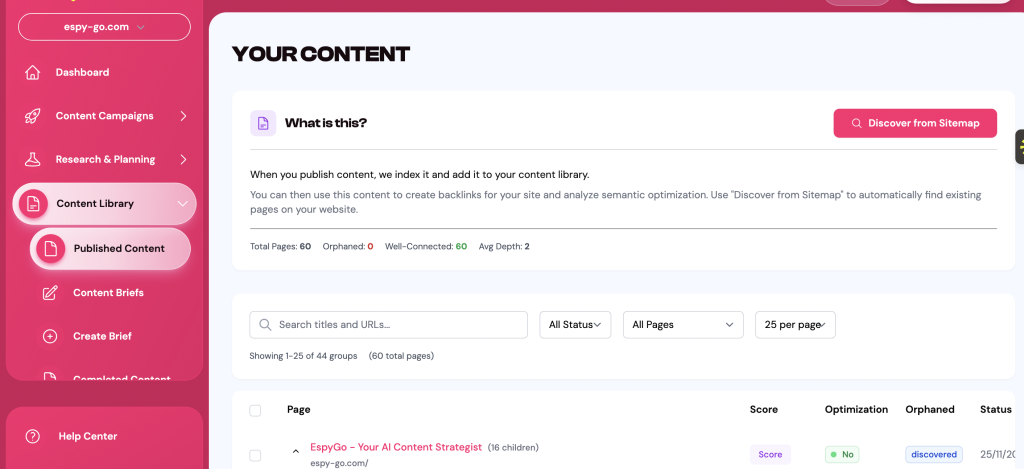
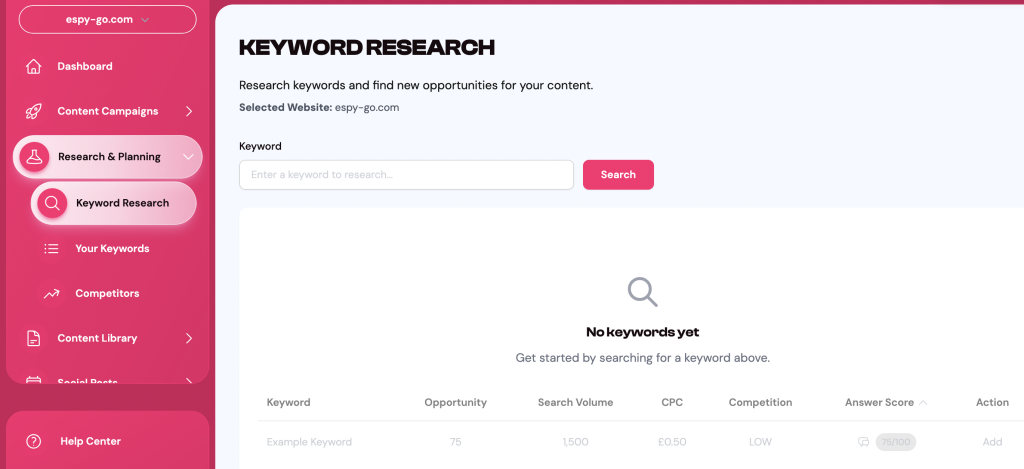
Most transformation roadmaps upgraded the CMS and CDP but left content operations stuck in spreadsheets and email. EspyGo sits exactly in that missing middle as the AI-native content operations layer that turns your £12M stack into visible AI-search authority instead of an expensive empty shell. It connects your SEO and analytics tools to governed content workflows, so instead of senior strategists hand-building briefs and agencies reinventing the wheel every time, you get:
- Strategy → brief automation: EspyGo turns your opportunity maps and content architecture into ready-to-execute, on-brand briefs in minutes, not weeks.
- AEO-native structure by default: FAQs, entities, schema and AI-search-friendly layouts embedded into every brief and draft as standard, not “nice to have”.
- Governed multi-market execution: central teams define voice, compliance and patterns once; regional teams execute and localise safely within those rails.
- Integrated workflows: EspyGo pushes briefs, drafts and metadata into your existing CMS, DAM and project tools – no rip-and-replace, no rogue sidecar tools.
Instead of AI sitting in a pilot deck and your headless CMS sitting half-empty, EspyGo gives you a repeatable, governed way to actually feed the stack you’ve already paid for – at a speed your current operations simply can’t match.
Conclusion: The Competitive Advantage of AI-Native Content Operations
Digital transformation programs succeed or fail based on their ability to operationalise new capabilities at scale. For content—the primary way customers experience your digital transformation—that means replacing manual, fragmented workflows with AI-native operations that provide both velocity and governance. The missing layer isn’t more AI tools, more headcount, or more agency spend. It’s the infrastructure that turns transformation strategy into executable content operations: governed automation, AEO-native structure, orchestrated workflows, and performance-driven planning.
Without this operational foundation, transformation delivers new technology without new capability—an expensive facade rather than genuine competitive advantage. The organisations that implement AI content operations infrastructure in 2024 will own share-of-voice in AI search while their competitors struggle with manual workflows that can’t scale, can’t govern, and can’t compete.
For enterprise digital transformation leaders: audit your current content operations against the four required capabilities. Where do manual processes bottleneck velocity? Where does lack of structure hurt AI search visibility? Where do governance requirements paralyse execution? These gaps define your roadmap for implementing AI-native content operations as the missing infrastructure layer in your transformation program.
The competitive advantage goes to organisations that close this gap first, while others watch competitors with inferior products but superior content operations capture their customers at the moment of digital discovery. The question isn’t whether AI will transform search and content—it’s whether your content operations will be ready when it does.
References:
- Rand Fishkin, SparkToro, “Clicks, Queries & the Invisible Web” (2024)
- Enterprise Content Operations Research, BrightEdge (2024)
- BrightEdge, “Share of Voice: AI Overviews and Featured Snippets Impact Report” (2024)