


Most AI SEO tools promise to revolutionise your content strategy, but half of them just help you write more rubbish faster. The challenge isn’t finding AI SEO tools—it’s finding ones that actually improve your content’s visibility and workflow efficiency.
Whilst every marketing professional is being bombarded with “game-changing” AI solutions, the reality is far more nuanced. You don’t need another content generator that churns out bland, generic articles. What you need are best AI SEO tools for content optimisation that solve real problems: faster keyword research, better content analysis, and workflows that actually save time whilst improving performance.
This guide cuts through the hype to show you 7 AI tools that solve real SEO problems with measurable results. We’ll cover how each tool fits into actual content workflows, who they’re best for, and how they compare in plain English—no marketing fluff, just practical advice from someone who’s tested these tools in real-world scenarios.
Whether you’re a marketing professional trying to prove ROI, a SaaS founder scaling content operations, or an agency owner looking to streamline client work, you’ll walk away knowing exactly which tools deserve your budget and attention.
How AI-Powered SEO Actually Differs From Traditional Optimisation
Speed vs Strategy: What AI Actually Improves
The biggest misconception about AI SEO tools is that they replace human strategy. They don’t. What they excel at is processing massive amounts of data and identifying patterns that would take humans weeks to spot manually.
Traditional SEO optimisation involves manually researching keywords, analysing competitor content, checking SERP features, and optimising content based on best practices. This process typically takes 3-4 hours per piece of content. AI-powered tools can compress the research and analysis phase into 15-30 minutes, but the strategic thinking—understanding your audience, crafting compelling angles, and making editorial decisions—still requires human insight.
Here’s where AI genuinely improves your content optimisation tools workflow:
- Data processing speed: Analysing hundreds of competitor pages in minutes instead of hours
- Pattern recognition: Identifying content gaps and opportunities across large datasets
- Real-time optimisation: Getting instant feedback on content performance as you write
- Scalable analysis: Running the same quality checks across dozens of pieces simultaneously
However, AI falls short on strategic elements like understanding brand voice nuances, making creative leaps that differentiate your content, and adapting to sudden market changes or trending topics.
The most successful AI content strategy combines automated analysis with human creativity. You use AI to handle the heavy lifting of research and analysis, then apply human insight to create content that genuinely resonates with your audience.
Why Most AI SEO Tools Miss the Mark
The AI SEO tool market is flooded with solutions that promise the moon but deliver disappointment. Most tools fall into these problematic categories:
Content generation over optimisation: Many tools focus on pumping out more content rather than improving existing content performance. You end up with volume without quality—exactly what Google’s algorithm updates penalise.
Lack of workflow integration: Standalone tools that require exporting data, switching platforms, and manual processes defeat the purpose of automation. If a tool doesn’t integrate with your existing content workflow, it creates more work, not less.
Overpromising on automation: Tools that claim to “automate your entire SEO strategy” are setting you up for failure. SEO requires ongoing strategic decisions that AI can’t make independently.
The tools that actually work focus on specific problems within your content workflow rather than trying to solve everything. They enhance human decision-making rather than replacing it, and they integrate seamlessly with the tools you already use daily.
The 7 AI SEO Tools That Actually Deliver Results
Research and Planning Tools
1. Frase for Content Brief Automation
What it does: Frase analyses top-ranking pages for your target keywords and automatically generates detailed content briefs including headings, questions to answer, and related topics to cover.
Why it works: Instead of manually researching 10-20 competitor pages, Frase does the analysis in 2 minutes and presents you with a structured brief. The AI identifies content patterns that human analysis might miss, particularly around semantic keywords and content depth.
Real workflow integration: Connect Frase to Google Search Console to prioritise content updates based on actual performance data. Export briefs directly to Google Docs or Notion for seamless handoffs to writers.
Best for: Content teams that need to scale brief creation without sacrificing quality—especially agencies managing multiple clients.
Pricing reality: Starting at £39/month; the time saved on research usually pays back within the first week.
2. MarketMuse for Content Gap Analysis
What it does: MarketMuse uses AI to audit your entire content library and identify gaps where competitors are ranking but you’re not. It provides topic suggestions based on your domain authority and existing content themes.
Why it’s different: Rather than suggesting random keywords, MarketMuse understands your content ecosystem and proposes topics that extend your existing expertise—leading to higher success rates for new content.
Workflow integration: Integrates with Google Analytics and Search Console to prioritise gaps based on search volume and difficulty. Content scoring helps you understand how comprehensive your coverage needs to be.
Best for: Established sites with 100+ pieces of content seeking strategic opportunities (not just net-new ideas).
The catch: Premium pricing from around £149/month suits agencies and larger teams more than solo practitioners.
Content Optimisation Platforms
3. Clearscope for Real-Time Optimisation
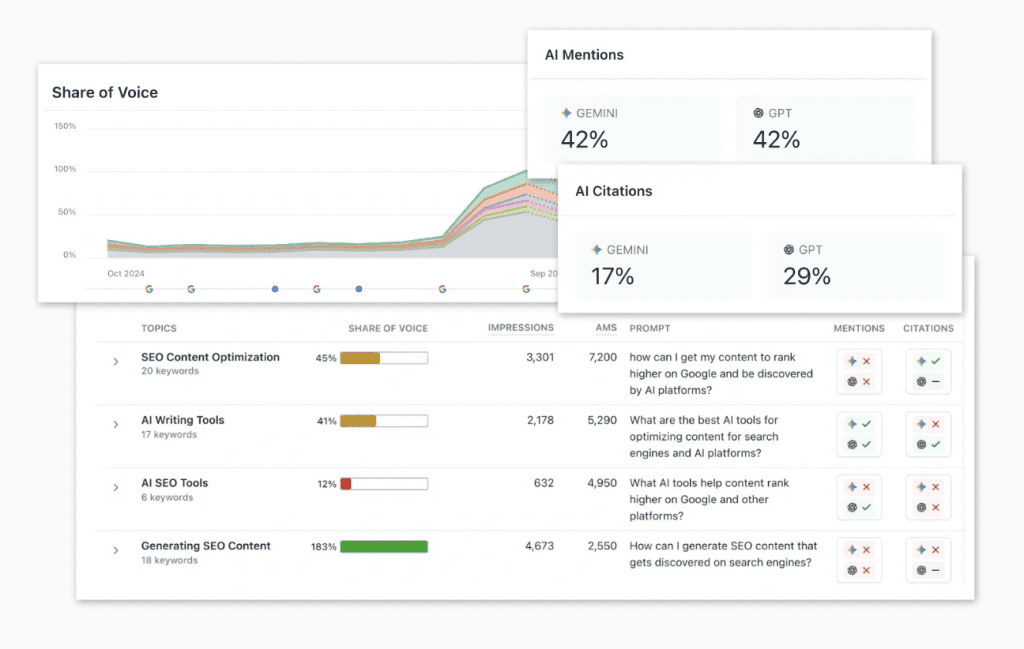
What it does: Clearscope provides real-time content optimisation as you write—suggesting related terms, ideal length, and readability improvements based on top-ranking pages.
The workflow advantage: Works inside your writing environment, so you get immediate optimisation feedback without derailing your creative flow.
Integration strength: Direct integrations with Google Docs, WordPress, and popular CMSs mean writers can optimise without tool-switching.
Performance tracking: Before/after scoring helps you correlate optimisation work with ranking improvements.
Best for: Teams that need consistent optimisation across multiple writers—without turning everyone into an SEO specialist.
Cost consideration: Around £170/month for the professional plan; reduced revision cycles typically justify the cost within a month.
4. EspyGo for AI + SEO Harmony (Content Optimisation & AEO)
What it does: EspyGo bridges traditional SEO and AI search. It structures content for semantic clarity, enforces tone and brand guardrails, and exports llm.txt (LEO Ranking) so AI systems like ChatGPT, Claude, and Perplexity can actually find and cite your work—true AI content strategy meets content optimisation tools.
Why it works: Instead of treating AI optimisation as an afterthought, EspyGo bakes it into the brief → draft → optimise loop. You get campaign-level guidance (topic clusters, buyer-journey mapping), draft acceleration with brand voice locked in, and answer-engine optimisation in one place.

Real workflow integration: Build briefs, generate first drafts, loop in feedback for regeneration, and ship CMS-ready content. The same campaign context powers SEO health snapshots and visibility insights across both Google and AI assistants.
Best for: Agencies and lean SaaS teams that need consistent, on-brand output that performs in both traditional search and AI-driven answers.
Pricing approach: Transparent, campaign-based plans that scale output without adding headcount.
5. Page Optimizer Pro for Technical Insights
What it does: POP analyses the technical and content factors correlated with higher rankings and provides concrete recommendations to improve existing pages.
Technical focus: Highlights opportunities like schema markup, internal linking adjustments, and page-level elements that commonly constrain performance.
Batch analysis: Audit multiple URLs at once—handy for large content libraries or at-scale refreshes.
Local SEO angle: Useful for businesses with local footprints thanks to location-aware optimisation suggestions.
Best for: Technical SEOs and agencies needing systematic optimisation, not just net-new content.
Value proposition: Low monthly cost (around £27) makes it accessible for consultants and small teams.
Performance and Measurement Tools
6. BrightEdge for Enterprise Tracking
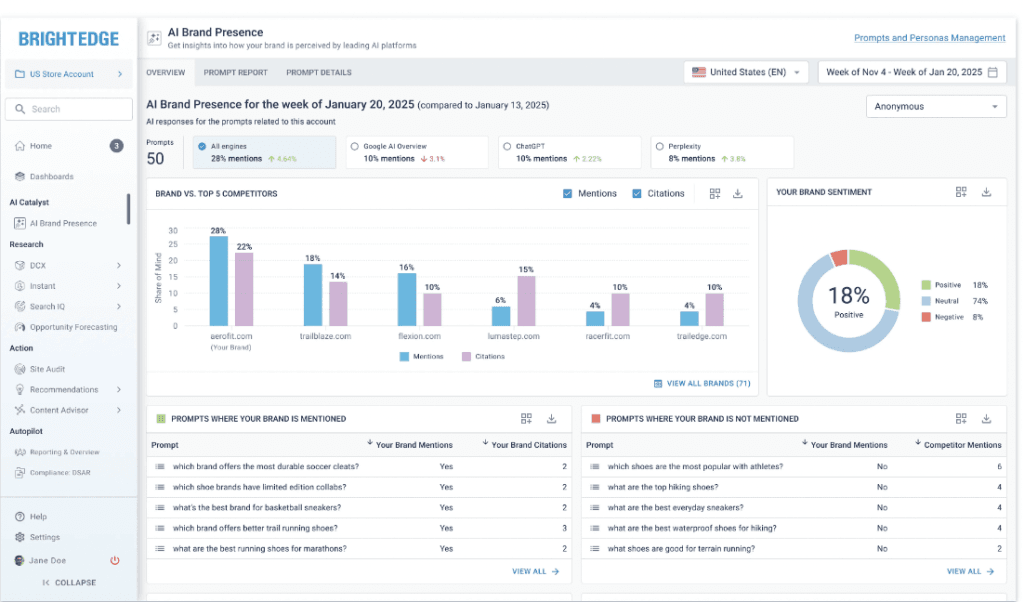
What it does: BrightEdge blends AI-powered content recommendations with robust performance tracking across organic, paid, and social channels.
Enterprise capabilities: Handles multi-site and multi-market complexity, with automated reporting that ties content to pipeline and revenue.
Predictive insights: Machine-learning models forecast performance and help prioritise content investments.
Integrations: Connects with major marketing platforms (e.g., Salesforce, Adobe, HubSpot) for full-journey attribution beyond rankings.
Best for: Large organisations with complex operations and stakeholder reporting needs.
Investment level: Enterprise pricing from around £500/month; appropriate when you need detailed attribution and governance.
7. Lumar (Deepcrawl) for Ongoing Technical Monitoring
What it does: Lumar continuously crawls your site to surface technical SEO issues that can quietly suppress content performance—then alerts you before rankings slide.
Automated monitoring: Tracks key changes to titles, meta descriptions, internal links, canonicals, and templates across your site, so regressions don’t go unnoticed.
Change intelligence: Historical crawl comparisons make it easier to correlate performance swings with specific technical shifts.
Best for: Teams managing large or frequently updated sites where manual checks aren’t realistic.
Pricing approach: Scales with site size and crawl frequency; best suited to mid-market and enterprise teams.
How to Choose and Implement the Right Tool for Your Workflow
Matching SEO Tools to Team Size and Budget
Small teams (1-3 people, under £500/month budget): Start with Clearscope for real-time optimisation or EspyGo for campaign + content optimisation + AEO, plus Page Optimizer Pro for quick technical wins. This covers the majority of best AI SEO tools for content optimisation needs without enterprise overhead.
Agency scale (4-15 people, £500-£2,000/month budget): Add Frase for brief automation and MarketMuse for strategic planning. The research and planning time you save repays the cost quickly when managing multiple clients.
Enterprise considerations (15+ people, £2,000+/month budget): Layer in BrightEdge for attribution and stakeholder reporting. Consider Lumar for continuous monitoring if site complexity is high.
Cost-benefit example: A 5-person team spending 10 hours per week on manual research can save around 7-8 hours with Frase + Clearscope/EspyGo. At £50/hour, that’s approximately £400 per week saved—easily covering £200-£300 in tool costs.
Implementation Best Practices
Start with one tool and master it: Pick the tool that addresses your biggest bottleneck (research, optimisation, or measurement). Implement fully before adding more.
Month 1: Train the team on core features and embed into your existing workflow.
Month 2: Measure impact (time saved, score improvements, rankings).
Month 3: Add a complementary tool (e.g., start with Clearscope → add Frase; or start with EspyGo → add POP).
Training tip: Budget 2-3 hours per person for onboarding. Advanced features often double the benefit.
Common Implementation Mistakes to Avoid
Over-relying on AI recommendations: Filter suggestions through brand voice and audience understanding. A financial services client saw rankings drop when they blindly followed AI suggestions that made their content less authoritative and more generic. Always maintain your unique perspective whilst incorporating technical improvements.
Ignoring voice consistency: Set guardrails so optimisation doesn’t sand off personality. AI optimisation tools focus on SEO factors, not brand character—establish content guidelines that preserve your unique voice.
Skipping training: Under-using a £300/month tool is costlier than not buying it. A marketing agency wasted 6 months using only basic features before proper training revealed advanced capabilities that doubled their efficiency.
Frequent tool-switching: Give each tool 90 days to prove impact before moving on. Mastering one tool thoroughly delivers better results than surface-level usage of multiple tools.
Streamline Your SEO Workflow with EspyGo
If you’re tired of juggling half a dozen tools that don’t talk to each other, EspyGo brings everything into one intelligent workflow—built for marketers who want outcomes, not more dashboards.
Streamlined Content Operations: Automate the manual parts of SEO—from keyword mapping and brief creation to content generation, optimisation, and refresh cycles—so your team focuses on strategy, not spreadsheets.
AI + SEO in Harmony: EspyGo ensures your content performs across both search worlds—Google’s algorithms and AI systems like ChatGPT, Claude, and Perplexity—by structuring every post with semantic clarity and discoverable metadata (including llm.txt for answer engines).
Visibility Insights That Matter: Track which posts are gaining traction, where your content appears in AI-generated responses, and how visibility improves over time—all in one clear dashboard.
Making the Right Choice for Your Content Strategy
The landscape of AI SEO tools continues evolving rapidly, but the principles of effective implementation remain constant. Success comes from choosing tools that genuinely solve workflow problems rather than chasing the latest features or marketing promises.
Consider your current biggest bottleneck: Is it research time, optimisation consistency, or performance measurement? Address that pain point first with a focused tool selection, then expand strategically based on proven results.
Remember that these SEO tools are force multipliers, not replacements for strategic thinking. The most successful content teams use AI to handle data-intensive tasks whilst preserving human insight for creative and strategic decisions.
The best AI SEO tools for content optimisation are ultimately the ones that make your existing expertise more efficient and effective. They should integrate seamlessly into your current workflows, provide measurable improvements in content performance, and scale with your team’s growth.
Start with one tool that addresses your biggest challenge, master its capabilities, and measure the results. Once you’ve proven impact, expand strategically to complementary tools that enhance rather than complicate your workflow.
Your content performance—and your team’s sanity—will thank you for choosing wisely, implementing thoroughly, and staying focused on tools that deliver genuine value rather than empty promises.
💡 Turn your content tools into a single, powerful SEO engine.
👉 Start your free trial at EspyGo.com